
Messages from Antiquity – Äänekoski Pendant
Olga Kolari |


Central Finland’s written history is short; little information from that time has made it into the history books. The past is told, however, by ancient artifacts and sacred places in nature. One local artifact is a Viking Age piece of jewelry found in Äänekoski, after which the Äänekoski jewelry has now been modeled. The Äänekoski Local Heritage Association conceived the piece and did the background work to chart its history. Goldsmith Sanna Hytönen crafted the jewelry based on this information.
- Choosing a local goldsmith was important to the heritage association, and Sanna Hytönen gladly took on an interesting and demanding task. So says Timo Enäkoski.
I meet Sanna Hytönen at Kivääritehdas in Tourula, because her studio in Suolahti is currently under renovation. It’s easy to get there from Äänekoski. There’s none of the typical parking-spot hassle of Finnish growth centers. The ease of the location for someone from Äänekoski was one reason to come to Kivääritehdas, but not the only one. At Kivääritehdas you also get to be part of a creative community.
- There are 12 of us artists here in total: sculptors, visual artists and artisans. The community’s support is significant, and a studio at Kivääritehdas had been a dream for years. The studio in Suolahti will remain, and from now on work will continue between Suolahti and Jyväskylä. You can drop by Tourula’s Kivääritehdas if you have other errands in Jyväskylä. People from Äänekoski have already found their way there, Hytönen says.
I ask what was most interesting in making the Äänekoski jewelry. In Sanna’s view, it was working with the Finnish Heritage Agency and delving into the piece’s symbolism. The jewelry shows a Finnish peculiarity of snake symbolism: studs. Elsewhere in the Nordic countries, there were no stud-jewels. In the Viking Age, every object had a magical meaning; they weren’t made just to look good. It remains to be seen whether we will ever learn all the messages the piece has concealed within it. The jewelry box also includes a booklet telling about the piece’s past. Antiquity and its mysteries fascinate modern people, unlike at the time the piece was found.
The jewelry is handmade in Suolahti
The popularity of the Äänekoski jewelry surprised its originators and the maker. The silver versions were sold out in record time. Next year, more will be made to meet the growing demand. What is the reason for the popularity? I believe that in a global world, the importance of local stories and one’s own roots is growing. The coronavirus year has reinforced the phenomenon in an unprecedented way.
- You can see how people are now interested in and proud of artisans’ products and their own region’s national costumes, Hytönen says. Timo Enäkoski noticed that the Viking Age is popular nowadays, and the perspective has been brought out in Äänekoski, for example in Ilona Pietiläinen’s Harjun Kaarti photoshoot.
The original purpose of the piece was to fasten a peplos skirt, a part of an ancient dress, to the underfabric. However, you don’t need to be an enthusiast of ancient costumes to wear the Äänekoski jewelry; it suits all kinds of clothing, for example as a brooch.
- The brooch pendant is really versatile and suits the modern day well. I myself wear it, for example, with a denim shirt. The elegant silver piece also works as evening-wear jewelry. One lady even used it to adorn an evening bag, Hytönen hints.
The piece has been designed to suit contemporary clothes. The original clasp was much thicker due to the heavy fabrics of the Viking Age. A heavier piece wouldn’t have worked with today’s lighter fabrics. Thickness is the only thing that has been compromised; otherwise the appearance follows the Finnish Heritage Agency’s originals precisely.
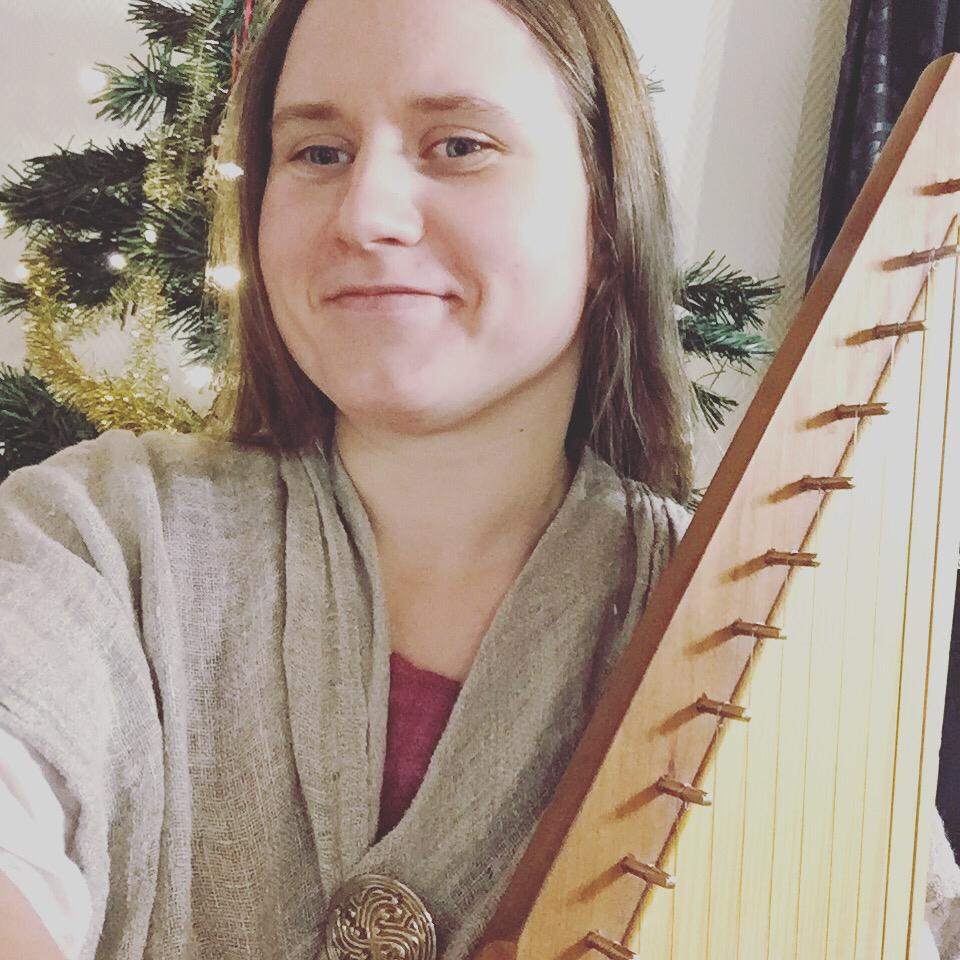
- Today I came not only for the interview but also to buy a piece myself. I immediately chose a bronze one. When Sanna says that in looks and clothing style there are “gold people” and “silver people,” I conclude that I’m a bronze person. After all, I have a brass-string kantele, and in the Kantele Competition I usually place bronze as well. Right after purchase, the piece will head with me on its first performance trip to Toivola’s Christmas Courtyard. Combined with linen clothes made by Helvi of Vaajakoski, it creates just the right ensemble and conveys values important to me: locality and craftsmanship. We also decided to make the Äänekoski jewelry part of the Mistica band’s look, so I ended up taking as many as three.
The Äänekoski jewelry received nice media attention both in the local papers and in Keskisuomalainen as well. As I drove to Tourula, I wondered whether I would gain a new angle on the piece’s story or if everything had already been told. During the interview, a customer came to see Sanna—she is the granddaughter of the late discoverer of the piece. In this rare photo is Eelis Kautto in his field in Mämme, where the original clasp was found. The photo has not been published before. Sometimes life brings the most amazing encounters, entirely unplanned and unexpected.
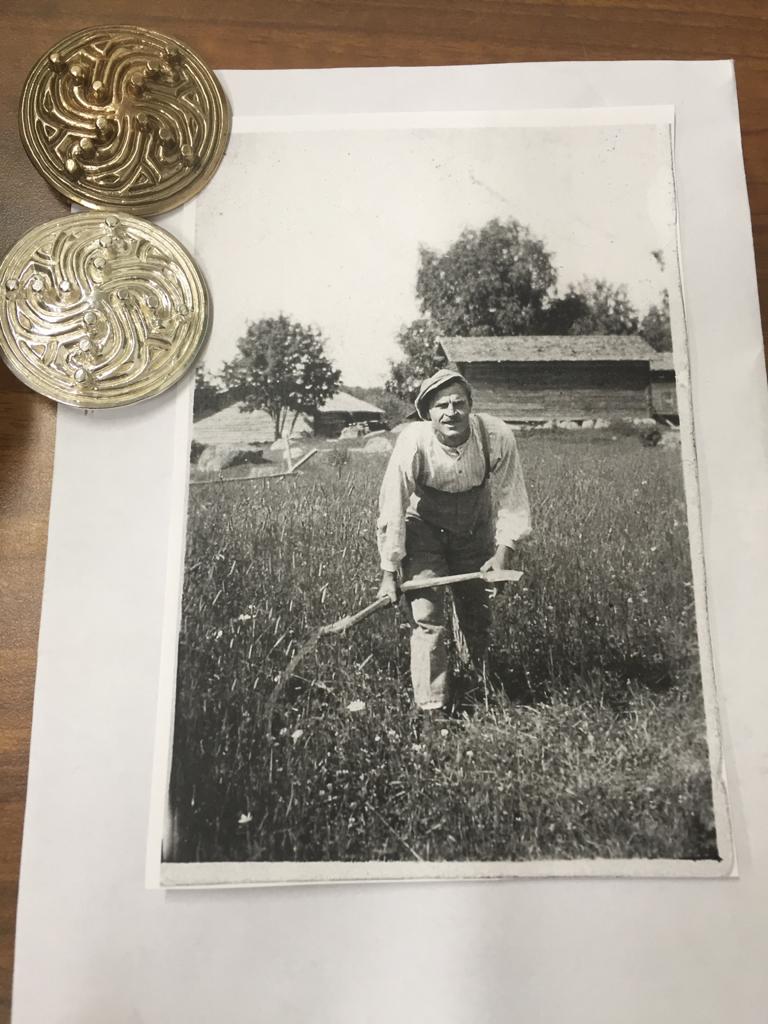
Eelis Kautto in his field, where the jewelry was found. Photo: Leena Juvonen’s archive
Ordering and buying the piece is easy. You can get it directly from Sanna Hytönen or via an order link. One chance to get to know the Äänekoski jewelry better comes on 18 December, when there will be a small sales event for them at Willen olohuoneessa ja keittiössä.
Welcome to explore local tradition in the form of a beautiful piece of jewelry!
- Olga Kolari